
Go Beyond Frequency
SplitEQ 2 goes beyond boosting and cutting frequencies. Patented Structural Split
technology separates the transient and tonal parts of the sound, enabling independent
shaping of each. Six dynamic bands, real-time masking visualization, and Global
Dynamics extend that control from individual tracks to the whole mix. Address problems
within a sound and make room for tracks to work together.
What’s New
Array
(
[0] => Dynamic Bands: Per-band compression or expansion that can act on the transient signal, the tonal signal, or both. Controls: range, threshold, ratio, attack, release, and Auto modes for each.
[1] => Sidechain for dynamic bands: Six sidechain options: broadband or in-band, each with all, split or external.
[2] => Global Dynamics: Global transient and tonal dynamics, routable pre or post.
[3] => Masking Visualization: Shows masking between competing sources in the main UI. A swap-direction option shows how either track masks the other.
[4] => Tracking Bypass: One switch bypasses every instance for zero latency, and one switch returns all instances to active mix mode. Aimed at overdubs and record-to- mix templates.
[5] => Assignable Bands for Stereo Processing: Assign any of the 8 bands to Left, Right, Mid or Side.
[6] => Source Tuning: New source types tailored to the transient/tonal split. Candidates: Distorted Guitar, Strings, Horn, Horn Section Woodwinds, Piano Synth Lead, Synth Pad.
[7] => Interface: enable and create bands directly from the plot; band carousel; progressive disclosure, and a scalable UI.
[8] => Filters: Improved high frequency filter response.
)
See Inside the Sound
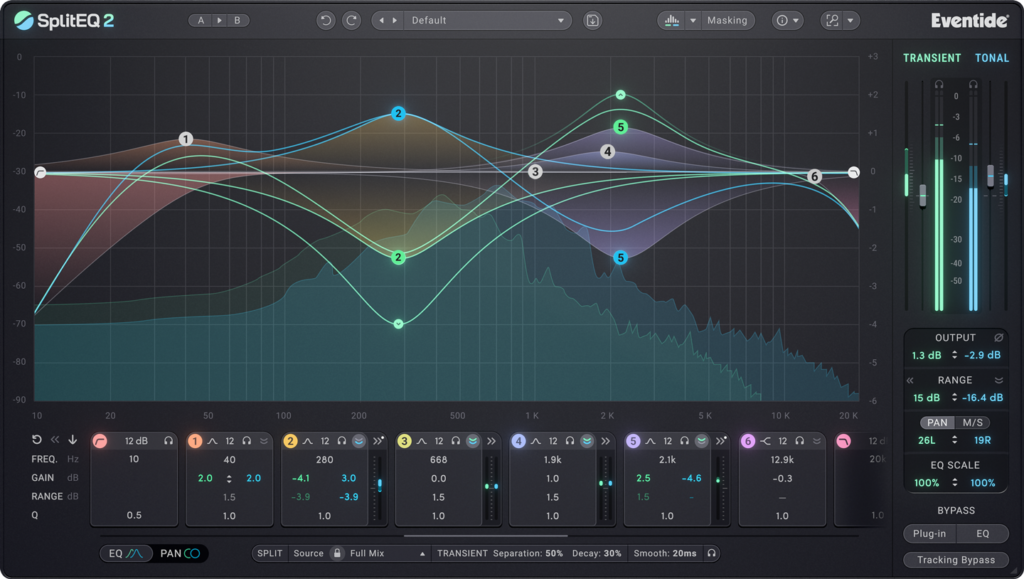
Structural Split™ separates transient and tonal content and displays both side by side,
revealing how each behaves in time and frequency. What appears as a single problem on
a conventional EQ, may be isolated to one component. Target the click of a kick, for
example, rather than the low-end thud. Create bands directly on the plot, access controls
through the Band Carousel, and reveal advanced options as needed to keep the interface
focused.
Independent Control. More Focused Dynamics.
Control how a sound hits and how it holds. Six dynamic bands apply compression or
expansion to transient, tonal, or both, targeting the part that needs changing. Threshold,
ratio, attack and release shape the response, with Auto modes as a starting point. Six
sidechain options select which signal drives the processing. For broader changes, Global
Dynamics adds transient and tonal control before or after the bands, bringing a drum bus
together or shaping the overall balance.
Less Clash. More Clarity
Seeing where sounds collide is only the start. SplitEQ 2 detects and visualizes masking in
the full signal. Instances share masking information across the session, and switching the
view reveals the conflict from either direction. Independent transient and tonal
processing powered by Structural Split™ offers a more selective way to respond. When
kick and bass compete in the low end, for example, a tonal cut can reduce the bass
sustain while preserving its attack, rather than applying the same EQ change to the whole
sound.
Stay in the Session
Switch from mixing to low-latency tracking in one move. Tracking Bypass temporarily disables
processing across every SplitEQ 2 instance in the session, making it easy to record without
bypassing plugins one by one. Switch back and full SplitEQ 2 processing returns instantly,
right where it left off.
requirements:
mac:
version: macOS 10.14+
notes: Intel and Apple Silicon
internet required: no
support:
64_bit
plugins:
VST-2
VST-3
AU
AAX
windows:
version: Windows 10+
internet required: no
support:
64_bit
plugins:
VST-2
VST-3
AAX
trial: no
notes:
feature: Six processing bands, each with independent transient and tonal separation.
Per-band compression or expansion on the transient part, the tonal part, or both
Range, threshold, ratio, attack and release per band and per transient and tonal, plus factory –tuned Auto modes
Six sidechain options: broadband key input, in-band frequency isolation, and external key inputs
64-bit double-precision processing across all bands and dynamic operations
Improved high frequency filter response
Candidate source types: Full Mix, Vocal, Kick, Snare, Tom, Cymbal, Full Drum Set, Electronic Beat, Hand Drum, Percussion Set, Piano, Bass, Guitar, Distorted Guitar, Strings, Synth Lead, Synth Pad, Horn, Horn Section, Woodwinds, General.
Band creation directly on the plot, Band Carousel, and progressive disclosure interface
Global Dynamics: global transient and tonal processors, routable before or after band processing
Real-time masking visualization between two active instances, with direction-swap viewing
Masking detection analyzes each track’s whole signal; transient/tonal split enables selective correction
Assign any of eight bands to Left, Right, Mid, Side, or combinations, with frequency- specific targeting
Transient and tonal processing remain independent within each stereo assignment
System-wide Tracking Bypass at zero latency, with one-switch return to full processing
Full M/S processing (stereo sources only)
licensing methods:
ilok
platforms: mac
windows
1247-158


